
Eventually, she decided that her story should not remain untold. She felt she had to share her emotions and experiences with other wives, mothers and sisters of military personnel, because their shared pain brings them together.
“I needed psychological support, and the courses I found through my own contacts helped me a great deal. But by uniting in communities and through public organisations, we must demand such assistance from the state,” Alla emphasised.
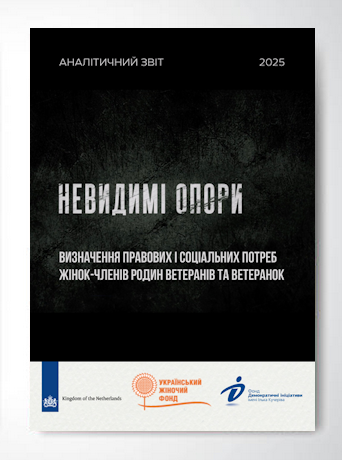
Alla shared her story with the Ilko Kucheriv Democratic Initiatives Foundation as part of the study “Invisible Support: Identifying the Legal and Social Needs of Women Members of Veterans’ Families”. The research was made possible through the support of the Ukrainian Women’s Fund and financial assistance from the Government of the Kingdom of the Netherlands.
To better understand the challenges faced by family members of veterans, and their perception of the role of the family in the lives of military personnel, the Democratic Initiatives Foundation conducted a series of focus group discussions with women from veterans’ families, as well as in-depth interviews with veterans themselves. The research helps identify which problems are systemic, what works and what does not in the current support system, and to what extent family members can influence adaptation and reintegration processes.
The Foundation decided to highlight the needs of veterans’ families in the public sphere and deliberately chose an approach that would make the topic accessible to a wide audience, regardless of their status, social role, or profession. This focus was intentional: family members often remain “invisible” in public policy, left out of both support programmes and public discussions. The advocacy work carried out during the project sought to change this situation. The authors of the study aimed to ensure that the category “family members of veterans” would be clearly defined and taken into account in veteran policy, rather than overlooked due to the absence of formal status or institutional visibility.
They focused not only on the problems faced by families, but also on the lack of understanding they encounter from society. An equally important task was communicating this to civilians. Even today, many Ukrainians have little understanding that the burden of war is shouldered not only by service members, but also by their families. This burden includes psychological stress, financial difficulties, and challenges in employment, education and social integration. Family members of veterans often have to combine their own responsibilities with constant care for their loved ones, while receiving minimal targeted support from the state or community.
Thus, the project’s approach combined two key dimensions: first, advocacy at the state level to ensure that the category “family members of veterans” is clearly reflected in policies and programmes; and second, informing the public so that society better understands the daily challenges these people face. Only the combination of these two approaches can bring meaningful change, both in policy decisions and in the attitudes of citizens toward this vulnerable yet critically important group.
Olha Petroye, the wife of a combatant, head of the university research department at the Institute of Higher Education of the National Academy of Educational Sciences of Ukraine (NAES), and Doctor of Science in Public Administration, notes: “The issue of the legal and social needs of women from veteran families, raised for discussion by the Ilko Kucheriv Democratic Initiatives Foundation, is critically important for modern Ukraine. Support for women who are members of veteran families directly affects the morale of defenders and, therefore, the national security of our state.
The research conducted by the Foundation’s experts is a significant contribution to documenting the problems faced by women from veteran families and women veterans themselves during the ongoing full-scale aggression. By identifying systemic gaps and highlighting the most urgent needs of veterans and their family members, the findings, conclusions and recommendations are invaluable for shaping a culture of support for veterans and their families in Ukraine. They also serve as a basis for public demand and advocacy aimed at improving the effectiveness of state policy on supporting veterans’ families.”
The report, prepared by the Foundation’s analysts, aims to make these “invisible pillars” visible, to give them a voice, identify their needs, and formulate specific recommendations for improving state policy in this area.
The full version of the research is available at:
https://dif.org.ua/uploads/pdf/151388655668998cf7d67294.83079870.pdf