

Russia’s full-scale invasion of Ukraine has radically transformed the security agenda and the requirements for rebuilding the state. At the centre of these changes is UN Security Council Resolution 1325, “Women, Peace and Security,” adopted 25 years ago, which has proven that women’s participation in conflict prevention, resolution, and post-war recovery is essential for sustainable peace. Ukraine became the first country to approve a National Action Plan to implement the Resolution during wartime, giving new impetus to the involvement of women in decision-making in the fields of security, defence and diplomacy.
The podcast featured Kateryna Levchenko, Government Commissioner for Gender Policy; Nataliia Karbowska, Director of Strategic Development at the Ukrainian Women’s Fund; Olena Starikova, officer of the National Guard of Ukraine; Liudmyla Huseynova, human rights defender; Olha Perunova, Deputy Head of the Human Rights Monitoring Department at the Ministry of Internal Affairs of Ukraine; Yevheniia Motorevska, Head of the War Crimes Investigation Department at The Kyiv Independent; and Halyna Skipalska, Executive Director of the Ukrainian Public Health Foundation (HealthRight International in Ukraine).
In her segment, Olena Starikova, an officer in the Armed Forces of Ukraine and the Head of the Gender Integration Service of the National Guard, spoke about the first time she received a uniform tailored specifically for women and how this symbolically changed her sense of visibility and respect within the army. Russia’s invasion in 2014 and the full-scale war in 2022 significantly accelerated gender processes in the military. In 2017, the National Guard established a Gender Integration Service with dedicated positions responsible for this area. This became a key step in recognising the role of women in the formation and development of military units. Attitudes towards women in the military are also gradually changing: “Stereotypes about women in the military are gradually diminishing, aided by personnel training and the introduction of the principle of equal opportunities. Although women sometimes have to prove their professionalism, all positions are open to them. The NGU notes career growth: among the graduates of the NGU Academy are commanders and deputy commanders,” Olena shares.
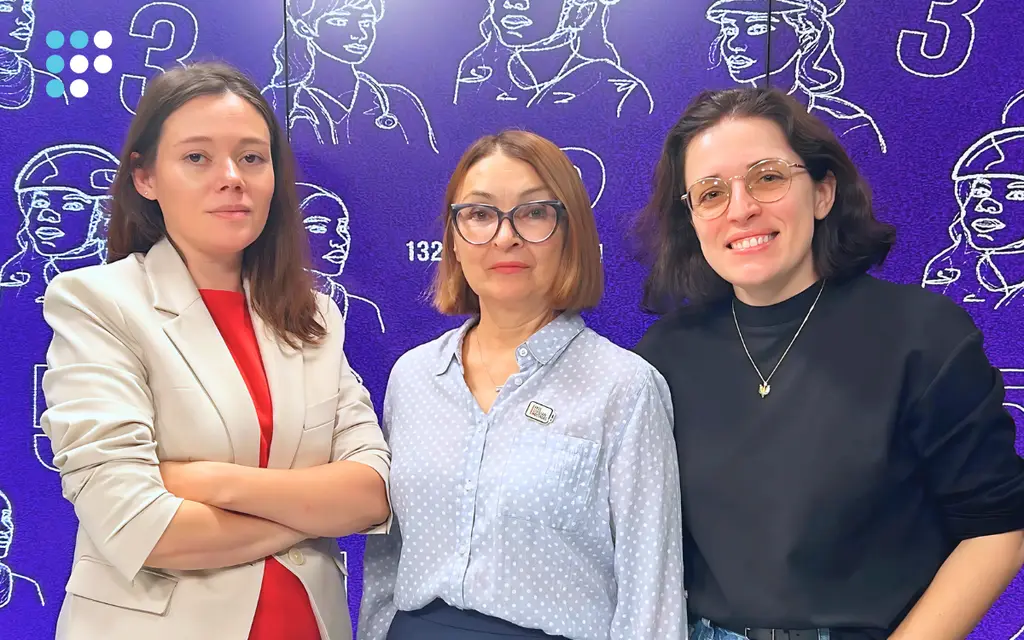 Another story featured in the podcast is that of Liudmyla Huseynova, head of the NGO Numo, Sestry! (“Come now, sisters!”), who spoke about conflict-related sexual violence (CRSV) as a form of warfare against civilians. Crimes committed by russian forces in the occupied territories were first discussed in 2014, but society at that time did not perceive them as war crimes. “Conflict-related sexual violence is a war crime, a form of military pressure on the civilian population. It is one of the forms of warfare, so to speak, against civilians. I know cases where such crimes were committed against civilians who were not in captivity but were living, unfortunately, in temporarily occupied territories. And these women – I know of several cases involving women in particular – are suffering just as much. They have no faith or hope for justice. A person who is in captivity, and you know that I myself have been through captivity and CRSV, carries consequences that cannot be overcome even with the help of psychologists. I am afraid for and feel pain for the women, girls, and men who are still in captivity. I understand the horror they are experiencing every minute. And there is no help available there, neither medical nor psychological. If women or men are held in cells that exert additional psychological pressure, it is terrifying,” says human rights defender Liudmyla Huseynova. She was released from russian captivity in 2022.
It was only in 2025 that Ukraine adopted a law on CRSV. It guarantees state support, reparations, and rehabilitation programmes at the national level. However, the law is currently not functioning due to the lack of necessary secondary legislation. Law enforcement agencies record survivors’ reports, but because of fear and mistrust regarding confidentiality, survivors remain alone with their tragedy even when they are in government-controlled territory.
The podcast “1325: Women, Peace, Security” reveals how the principles of Resolution 1325 are being implemented in Ukraine, from government offices and diplomatic negotiations to small communities that are fighting for peace and security for their residents. These conversations are not only about policies and strategies, but also about the living voices of women who are changing the rules of the game and proving that victory is impossible without equality. At the same time, it is important to remember that change does not happen overnight. It requires time and effort, and such stories help highlight the role and contribution of women in achieving peace and security in Ukraine, increase public awareness of the principles of Resolution 1325, and encourage their implementation at the national and local levels.
The photos provided by Hromadske Radio.